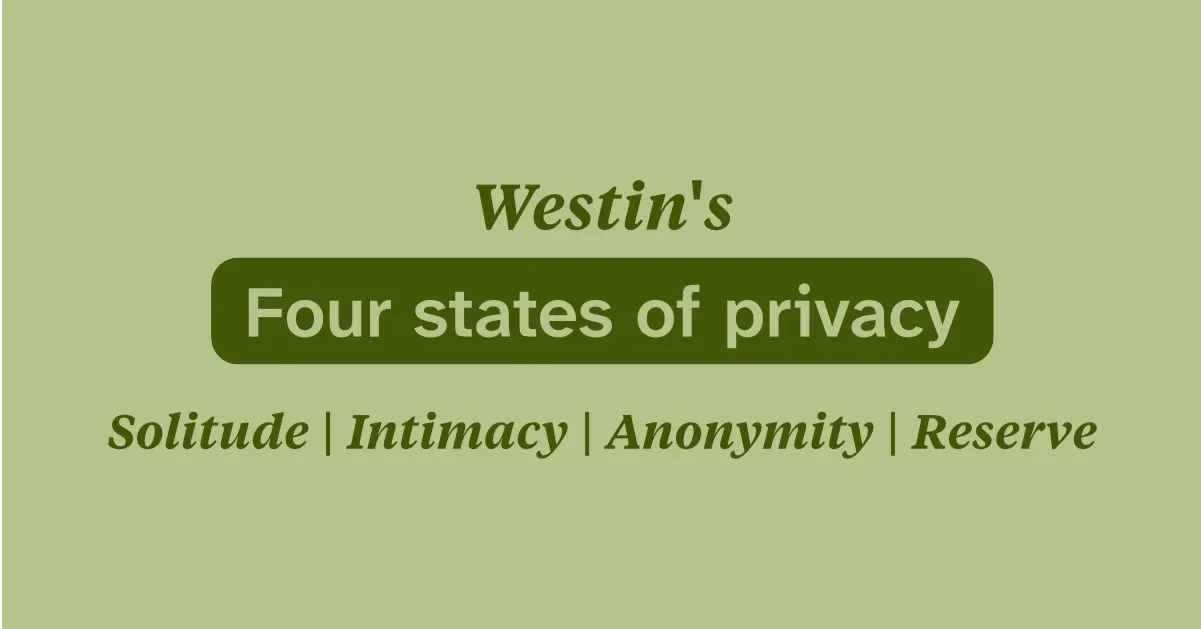
Westin's four states of privacy
We all sense that privacy matters. When someone reads your texts over your shoulder, something feels wrong. When strangers ask personal questions, we get uncomfortable. We instinctively value privacy, but explaining why is surprisingly hard.
Today’s digital world makes this even harder. People don’t need to stand behind you to read your texts. Data brokers collect your personal information without your permission.
We feel our privacy is being violated. But we can’t always explain what we’ve lost, or why it feels so invasive.
Alan Westin—a pioneer of privacy
Alan Westin (1929–2013) was a privacy researcher whose work helped shape modern privacy theory. His book, Privacy and Freedom1, has influenced decades of research and policy discussions.
Westin proposed that we can understand privacy through the different states we move between throughout our day. And that these states support the functions of privacy.
Others have since built on his ideas, but the four states of privacy remain one of the most influential ways to understand privacy.
Why privacy matters: The four functions
Privacy isn’t just about hiding information. It’s about creating spaces where we can think freely, feel safely, and connect with others. Without privacy, we lose the essential conditions we need to maintain mental health and meaningful relationships. As a result, privacy is widely recognized as a fundamental human right.
But what does privacy actually give us? Westin identified four key functions that privacy serves in our daily lives:
Personal autonomy lets you make choices about your life without outside pressure or manipulation.
Emotional release lets you express feeling and process experiences without judgment.
Self-evaluation lets you develop your personal identity through honest self-reflection.
Limited and protected communication lets you share different parts of yourself with different people based on your relationship with them.
These functions depend on our ability to control when we’re observable, and to whom. Without that control, we lose the capacity to think clearly, process emotions in healthy ways, and build human connections.
Understanding the four states of privacy
Westin described four distinct states that people can be in—solitude, intimacy, anonymity, and reserve. Each state reflect one of the ways we control information about ourselves in different settings.
Let’s have a closer look at each one.
Solitude: Freedom from observation
Think of being alone in your bedroom with the door closed. You’re free to be you. Free to read, watch, or wear whatever you want. If you live with a big family, you might lock yourself in the bathroom to give yourself a moment to think.
Out of the four states, solitude is the most complete state of privacy. You have total control over the information about yourself.
Intimacy: Sharing in close relationships
Intimacy occurs when you’re in small group settings where you feel comfortable sharing personal information. It might be a conversation with your spouse or dinner with close friends. You might share things in therapy you wouldn’t want others to know.
The key to intimacy is that everyone present has agreed to keep shared information private, either explicitly or implicitly.
Anonymity: Blending into the crowd
Anonymity exists in public spaces where you can blend into the crowd to become unrecognizable and unnoticed. For example, walking through a busy shopping mall or riding public transportation. You’re visible yet effectively invisible.
Reserve: Controlling personal disclosure
In reserve, you’re selective about the information you share. For example, when you’re at work, you may share professional opinions. But you keep personal beliefs to yourself. You’re in a context where you decide what to reveal about yourself.
Moving through privacy states in daily life
Here’s how you might move between these states throughout a typical day:
In the morning, you wake up and check your phone before getting out of bed. You’re in solitude—in complete control of your information environment.
During breakfast with your family, you shift into intimacy. You discuss personal matters and share concerns about the day ahead. You can speak freely because you trust each other to keep family discussions private.
Your commute to work puts you in anonymity. You’re surrounded by strangers who don’t know who you are, allowing you to read, listen to music, or think without feeling observed or judged.
At work, you operate primarily in reserve. You share professional opinions and engage in small talk with colleagues. But you keep personal matters like political views or family struggles to yourself unless you choose to share them with specific people.
We naturally transition between states throughout the day, even at a moment’s notice. Your boss might walk in while you’re having a private conversation with a close colleague. Or you might bump into an old friend while you’re out shopping.
Connecting states to privacy functions
The privacy states create the conditions needed for privacy functions to work. Each function can be supported by multiple states depending on the situation.
Personal autonomy: You might draw on solitude to think through major decisions without outside influence, or use reserve to test out new aspects of your identity in different social contexts.
Emotional release: The solitude of your bedroom provides space to process difficult emotions, while the intimacy of close friendships offers a safe place to express vulnerability.
Self-evaluation: You might need solitude to reflect on your values and choices, or work through them in intimate conversations with a trusted friend or therapist.
Limited and protected communication: You might be vulnerable with close friends while maintaining professional boundaries at work, using intimacy and reserve to share different parts of yourself with different people.
The privacy states are critical to accomplishing the different functions. When we lose access to a state, it becomes harder to engage in the activities it affords us.
Recognizing threats to privacy states
Think about a time when you thought you were in one privacy state but then found out you weren’t. Whether you misjudged the state you were in, or someone violated it, you likely felt vulnerable or even scared.
If you can’t remember a time, imagine these scenarios:
- Someone watching you when you thought you were alone (solitude)
- Someone listening in on a private conversation with your best friend (intimacy)
- A stranger following you all the way to your house (anonymity)
- Someone pressuring you into giving up sensitive information (reserve)
Now imagine a world where every privacy state was permanently unavailable. You could never be truly alone or share intimate thoughts with someone. Wherever you went, people would know who you were. Strangers would have access to your intimate thoughts, medical records, and financial information.
Unfortunately, this is already becoming our digital reality.
Privacy states are typically more accessible to some individuals than others. Public figures or people who are visibly different from the crowd will likely have a harder time blending in. And not every family can afford a house where everyone has their own room.
In the online world, privacy-friendly alternatives often cost more, as many free services are financed through privacy intrusions. Some service providers even let you choose whether to pay with money or personal information.
Protecting privacy in digital spaces
Unlike physical spaces, digital spaces have made privacy intrusions the default. Privacy violations in physical spaces are more obvious and limited. But digital violations are different.
Here’s how each privacy state may translate into its digital counterpart:
Digital solitude is perhaps the hardest to achieve. Think you’re alone when browsing the internet late at night? Your internet provider logs every website you visit. Your phone tracks your location even when you’re not using apps.
Digital intimacy happens when you share personal thoughts through messaging apps or video calls with close friends and family. But unlike whispering secrets in your bedroom, your messages are sent through company servers where they could be read, stored, or analyzed.
Digital anonymity should let you browse, shop, or explore online without being identified. But even when you think you’re anonymous, websites track your behavior through cookies, browser fingerprints, and purchasing patterns. This data can be combined to create a detailed picture of your daily routine.
Digital reserve is what most people practice on social media. You might post vacation photos for friends but keep your political views private. Or share professional updates on LinkedIn while hiding personal struggles.
Because digital privacy violations aren’t directly visible, it’s easy for companies to take advantage. They frame tracking as “personalizing your experience” or data collection as “improving our service.” But each small intrusion makes it harder to achieve the solitude, intimacy, anonymity, and reserve that healthy human functioning requires.
A vocabulary for privacy
After nearly 50 years, the four states of privacy remain one of the most practical ways to understand privacy. They help you recognize not just that privacy violations feel wrong, but why they feel wrong.
- When a social media platform changes privacy settings without warning, it’s disrupting your ability to maintain reserve.
- When a fitness tracker monitors your sleep and shares data with insurance companies, it’s violating your solitude.
- When a messaging app isn’t end-to-end encrypted, it’s undermining the intimacy you thought you had.
The next time you feel that familiar discomfort about a digital privacy issue, ask yourself: Which privacy state is being threatened?
Privacy and Freedom by Alan Westin, 1967 (later republished in 2015) ↩︎

Comments
Leave a comment by replying to the post on Bluesky or Mastodon.